
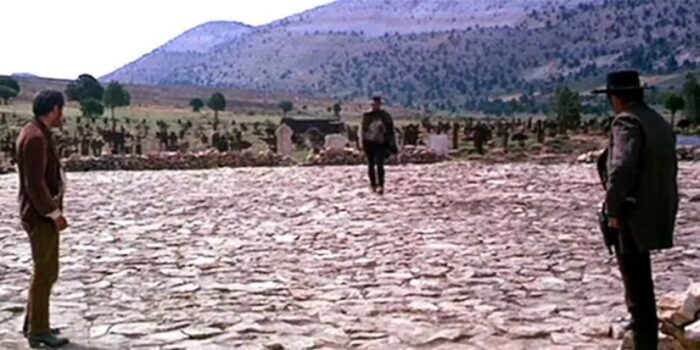
You, Deadeye Dick & Charles the Crusher have insulted each other. All demand satisfaction. Three-way pistols at Dawn! You shoot first, then Deadeye, then Crusher, and so on in succession, until one walks away. Deadeye never misses. What is your best strategy?
Prove it. It’s not easy. Don’t cheat. Don’t use AI. If you use AI, you will learn nothing and have no fun.
MEANWHILE: BUY THIS BOOK.

The Solution
For educational purposes, after I worked up what I thought was the general solution, I discovered, via Grok, that this is a well-known problem in game theory. Which I should have guessed. But didn’t, which proves my ignorance.
Anyway, I first saw this problem in Fred Mosteller’s Fifty Challenging Problems in Probability with Solutions, and thought it was fun. He gave explicit probabilities for each shooter, and provides a nice and tight solution. Not challenging enough for my discerning readers, I thought, so I let the information be open, except about Deadeye, for even more fun.
In any case, the danger of using AI is that it only had versions of Mosteller’s solution, in which it is also known by all shooters that you are the worst shooter. In that classic version, the best strategy (as we’ll see) is for you to shoot into the air; Deadeye then takes out Crusher, and you get one shot at saving your life. Make sure your Second knows what to do with your remains.
In our version (which is known in game theory), Deadeye doesn’t know you are worse than Crusher. Deadeye has to form a decision (i.e. guess). Then matters get interesting.
Now this is the kind of thing that, I think, is easier explained visually than in words, so do watch the Video (I already know you subscribe at YouTube) if you can’t follow the description.
Setup
You believe your chance of hitting any man is p. You and Crusher believe Deadeye never misses (he never has). You think (using whatever evidence is at hand) Crusher’s chance of hitting his mark is q. You don’t know what else is on anybody’s mind, but you assume Deadeye’s assessment the chance you are better than Crusher is some number m; which means (1-m) is his assessment of the chance Crusher is better. Except for Deadeye, who never misses, both p and q are strictly between 0 and 1; i.e., everybody has a chance, but Deadeye’s choice is not certain.
You have one of three strategies.
Strategies
Strategy 1: You fire at Deadeye
If you hit (chance p), Deadeye’s out; then Crusher shoots at you (chance q); if he hits, you’re out; if he misses (1-q), you shoot back at Crusher (p), and so on back and forth until the last man standing.
If you miss (chance 1-p), then Deadeye either shoots you (chance m) or Crusher (chance 1-m). If it’s you, you’re out. If Crusher, you get one more shot at Deadeye, and if you miss it, you’re out.
Strategy 2: You fire at Crusher
If you hit Crusher (chance p), then Deadeye shoots you (certain); if you miss, then Deadeye chooses between you and Crusher as above.
Strategy 3: You fire into the air, or otherwise forfeit your opening shot
Then Deadeye chooses between you and Crusher as above.
Chances You Live
Strategy 1: You fire at Deadeye
If you hit Deadeye (chance p), you have to hope Crusher misses you (1-q), and that you hit (p); or that if you miss (1-p), Crusher misses again (1-q) and then you hit (p); and so on. The only path in which you live is that you hit Deadeye and Crusher continuously misses, and you finally hit him once.
Thus the chance you live is
$$p \left( (1-q) p + (1-q)^2(1-p)p + (1-q)^3(1-p)^2 p + \cdots \right) = p^2\frac{(1-q)}{1-(1-q)(1-p)},$$
because the inner term can be made into a geometric series by first factoring out (1-q)p and recognizing (1-q)(1-p)<1.
If you miss Deadeye (chance 1-p), he may shoot you (chance m) and you’re out; or he may shoot Crusher (1-m), and then you have one shot (p) to get Deadeye.
In this event, the chance you live is (1-p)(1-m)p.
Thus the chance you live with Strategy 1 is
$$p^2\frac{(1-q)}{1-(1-q)(1-p)} + (1-p)(1-m)p.$$
Strategy 2: You fire at Crusher
To live, you hope you miss Crusher (1-p) and that Deadeye chooses Crusher to shoot first (1-m), and then hope you hit Deadeye on your last shot (p).
The chance you live with Strategy 2 is thus (1-p)(1-m)p.
Strategy 3: You fire into the air, or otherwise forfeit your opening shot
If you fire into the air (or the like), then Deadeye might choose to shoot you (chance m) or Crusher (chance 1-m). If he shoots you, you’re out. If he shoots Crusher, you get one shot at Deadeye. Make it good.
The chance you live with Strategy 3 is (1-m)p.
What Is Optimal?
First off, if you believe Deadeye is dead set against you, i.e. that m = 1, then your only choice is Strategy 1. In both 2 and 3 (with m = 1) you think Deadeye is going to blow you away. You may as well take a shot.
If you think Deadeye has a grudge against Crusher, i.e. that m = 0, or that you’re not sure (m < 1), then things are different. So next we only look at cases where m < 1.
You’d pick Strategy 2 over Strategy 3 if
$$(1-p)(1-m)p > (1-m)p.$$
That is if
$$1-p>1,$$
which will never happen. So you opt for Strategy 3 over 2. The key is that Deadeye’s choice doesn’t really matter. In the original problem, m = 0, and Deadeye always picked Crusher over you. So nothing changes, and really oughtn’t because why in the world would you shoot Crusher knowing that if you hit him you’re dead?
You’d pick Strategy 1 over Strategy 3 if
$$p^2\frac{(1-q)}{1-(1-q)(1-p)} + (1-p)(1-m)p > (1-m)p.$$
or (after a little manipulation) when
$$m>1 – \frac{1-q}{1-(1-q)(1-p)}.$$
Now you can play with that, but it doesn’t admit to much helpful simplification. The denominator on the right is guaranteed to be less than one, but for many values of p and q the numerator can be small, so the right side is not necessarily less than 1. Which means it is possible that the right hand side is less than 0. Since any m will be greater than that, in those cases you pick Strategy 1.
Discussion
The original problem had m = 0 (Deadeye is certainly going to shoot Crusher first). But it also had q > p, and it’s easy to see (and we will see again) that this makes sense. If p > q, the result might be different. And is.
Consider that if you believe you hit with some high chance (p), and you think Crusher stinks and you believe Deadeye will go for Crusher first, then in Strategy 1 if you miss your first shot (low chance of miss), you get one more shot (high chance). That chance (from above) is (1-p)p, which is high is p is high. But it’s still lower (with m = 0) than Strategy 3 which gives chance p. What rescues Strategy 1 here is that extra bit you get if you first peg Deadeye.
This is only an advantage (it’s easy to see) if
$$q < \frac{1-p}{2-p}.$$
This is those times in which q < 0.5. For instance, (recalling m = 0), if p = 0.5, then q must be less than 1/3 for Strategy 1 to beat 3.
Yet notice what happens when p = 1, i.e. you think you’re certain to hit. Then you choose Strategy 3, because q < 0 is impossible. This makes sense, too, because if you are certain to hit, you waste your first shot, then Deadeye takes out Crusher (with certainty), then you (with certainty you think) take out Deadeye, with no risk to yourself.
Okay, we’ve done m = 1 and some m = 0, but now let’s look at that formula for when m is in between. Again, we opt for Strategy 1 over 3 when:
$$m>1 – \frac{1-q}{1-(1-q)(1-p)}.$$
That is this picture (when p > 0.5):

Here’s how to read this. Remember, the larger the m, the more likely you think Deadeye targets you. Each value on a contour is the result of the right hand side of the equation just above. You must believe m is great than this, at your particular p & q, to opt for Strategy 1, else you go for 3.
For instance, suppose you think (based on whatever evidence) your p = 7/10 and Crusher’s q = 2/3. The value of the equation is about 0.6 here. If you think m > 0.6, then go for Strategy 1, else pick 3.
The plot has a nice logic. The better you believe Crusher is, the more likely you think Deadeye will target you is when you should go for 2 and get in that first shot.
For p < 0.5 we have this:

I stopped computing for q < 1/3 because the lines, all negative numbers, get tighter and tighter and provide no useful information for us. You can see the 0 line.
The original problem had p = 0.3 and q = 0.5—and also specified m = 0. If Deadeye doesn’t have certain knowledge, we can see that you ought to stay with Strategy 3, as in the original problem, until m > 0.2, then you’d switch to 1.
This picture can help.

This is the probability of you making it under Strategy 1 (black) and Strategy 3 (red) for all p and q when m = 0; i.e., the classic puzzle. At p = 0.3 and q = 0.5, Strategy 1 gives less than 0.3 chance of survival, whereas Strategy 3 it is 0.3, and where q is always irrelevant.
When the inequality is less than zero, obviously all m > 0 will be greater than this, so you opt for Strategy 1. One example from the picture just before this is p = q = 0.2. Strategy 3 gives 0.2 (it’s always p), but Strategy 1 give 0.25, which is of course better.
Tricks
Obviously it’s better for you to have m be low; ideally 0. How can you do that? Given you go first, and before your turn commences, you might try various stratagems to convince Deadeye you’re less of a threat than Crusher. How you do that is wholly a function of circumstance.
Even better. What do you do if you don’t know Deadeye’s a dead shot? I leave that for homework.
Good luck.
Video
All my work is free and user-supported. Here’s how to help:
- Subscribe at Substack (paid or free!)
- Cash App: $WilliamMBriggs
- Zelle: use email: matt@wmbriggs.com
- Buy me a coffee
- Paypal (try $1 a month!)
- Other credit card subscription or single donations
- Hire me
- Subscribe at YouTube
- PASS POSTS ON TO OTHERS
Discover more from William M. Briggs
Subscribe to get the latest posts sent to your email.
