

Here are a few typical photographs or stills from videos provided by our most beneficent government in its recent “release” of UFO files. (You will all recall my recent UFO Reports About To Blast Off, which came out before the government actions.)


There are many, many more: I picked these to give only a feel. But I think they are also representative, and you are welcome to check for yourself.
Past Blast
Now here are one or two other, earlier photographs, from the mid Twentieth Century:

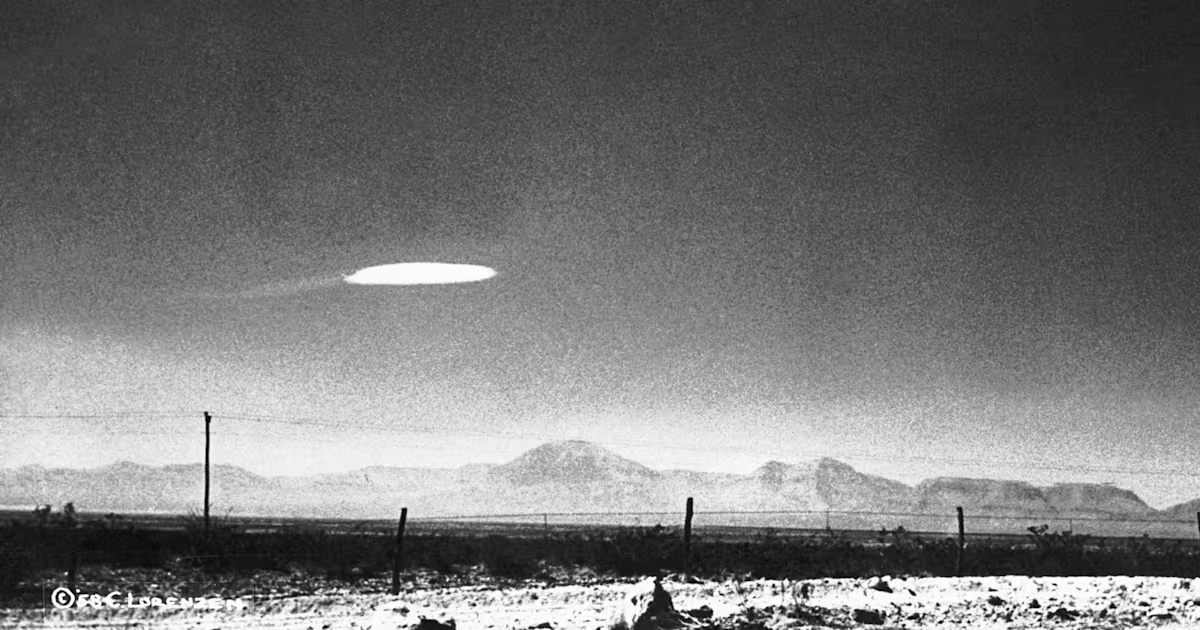

Again, there are a blizzard of these, and I hope you agree that my picks do a reasonable job representing the genre.
Say Cheese
Finally, two more pictures, and then we move on to something else:


The first was a Kodak camera circa 1950, common in its day. The second is, as you know, an iPhone. This I think is model 17. A prime selling point (besides social cache) are its cameras. Top quality stuff. As they say (in part):
Across the iPhone 17 Pro camera system, you’ll find innovation that goes to great lengths. The telephoto features the next generation of our tetraprism design and a 56 percent larger sensor. With an equivalent 200 mm focal length, the 8x optical-quality zoom makes this the longest iPhone Telephoto ever — offering 16x total optical zoom range. So you can explore an even wider range of creative choices and add a longer reach to your compositions.
Those mini-cameras really are terrific. They beat the pixels off the home movies my grandparents used to take with a Super 8 camera. As evidence, here is the first video I came across when scrolling Twitter when I was writing this. I don’t know if it was recorded from a iPhone or some similar platform like Android. This one, for reasons known only to the Twitter algorithm, is of Indian street food. The quality is excellent. Not the food: the footage (I’d have to be paid a lot of money to eat that food). The account that posted this video has thousands of others, and doubtless you know how to find hundreds of thousands, even millions, more.
And here (I won’t paste it in) is the first still picture the algorithm showed me, a burned shrine in Japan (it seems shrines and churches are burning at a fairly rapid pace wherever Diversity appears). Again, you will know where to find millions upon millions upon millions more pictures. The numbers are not mere rhetorical flourish. They are, if anything, an understatement. Billions is surely more accurate.
Sans UFO
My argument why there are (probably) no UFOs is both obvious and well worn, but with a twist. (Apropos of nothing, a million years ago when I first got to Japan I saw a commercial for UFO instant noodles, and was charmed they pronounced the letters as a word, and not letters: you-foe.)
Look again the the UFO pictures, both current and old. The are strikingly similar, are they not? They are all blurry, show clear signs of equipment aberrations (like lens flares, smudging, ill focused, electronic noise, mistaken settings, dust, all discussed here).
All pictures are at the edge of detection. An edge which ought to have been reached in three quarters of a century between the first and newest pictures. Because the technology of image capture improved, for any metric, by orders of magnitude.
Yet the better the cameras got, the more the edge receded.
Here again is the key picture from my earlier UFO predictions:

This is the number of UFO reports by year (on a log-10 scale), overlayed with the number of cellphones (in red). Obviously the more cellphones there are, the more cameras there are, and the more cameras the more edge-like pictures of UFOs.
There is never a clear and sharp video of UFOs as there are for ordinary objects, like that food stall or the burnt shrine. There are even many videos and pictures of airplanes, and some amateur astronomers from the ground have pictures of the Space Station! See this one of a plane crossing the sun. There have been some clear pictures and videos of what are claimed to be UFOs, but they all prove to be frauds or mistakes. We are left with hundreds of ambiguous images which require layers of interpolation and explanation. And hope.
Both population and technological capability have increased since the first UFO craze in the 1940s. Yet the evidence remains of the same quality. If UFOs were there, sharp pictures and videos ought to exist. They do not exist. Instead, we get vague shapes. Did you notice the new pictures are mostly and curiously black and white, just like the old ones? That’s because the new ones offered as evidence are often taken in the infrared spectrum, which are necessarily blurrier. Infrared cameras did not exist in similar capability or number before.
That’s why the edge receded. The new equipment can record kinds of images the old cameras couldn’t handle. But even the new has limitations, and so we see these unclassified images at the edge of detection. We don’t seen iPhone-like quality sharp color pictures of aliens waving from spaceship portholes, which we might expect if UFOs are common, and instead we get unspecific vague imagery, just like we used to when cameras were in their infancy.
“Climate Change”
The same thing happens in other weak branches of science, most infamously in parapsychology. Effects using crude measures, like weakly shuffled decks of cards, were intriguing and hopeful, and generated lots of initial excitement about ESP and the like. Better methods were quickly invented to hone in on spectacular claims. Yet the closer we looked, the weaker the effects became; like above, the goal receded into the distance. Detection remained on the edge, always on the edge.
The example you’re more familiar with is “climate change”. We recall early predictions of mass deaths, crop failures leading to famine, wars and rumors of wars, destructive swings in temperature and weather, drought-floods, snow-hurricanes, atheists professing God. Real end-of-the-world stuff. And unmistakable. Just like with UFOs, anybody ought to have been able to look out their window and witness the enormous ravages of “climate change”.
Yet after the initial excitement, the closer scientists looked the smaller the effects became. And the more the name for the “crisis” was modified to our now bland and meaning-free “climate change”. We hear, and hear routinely, claims that last month was “the hottest ever”. But these claims are highly massaged by layers of models, which produce signals almost imperceptibly above the noise. Instead of whole degrees of temperature change, which we were promised and which we ought to have seen by now, the claims are now about hundredths of a degree. Meaningless to any practical concern.
Just like with UFOs and parapsychology, the effects of “climate change” can only be seen reliably by believers. Indeed, this is why skeptics of “climate change” are called “deniers.” Not for rejecting or disputing evidence: for not believing. This, incidentally, is why people also ask you if you “believe” in “evolution.” And where that word is never or loosely defined, or the definition is allowed to equivocate. All that’s needed in these disputed fields is that you signal your willingness to believe the Expert consensus.
You do not have to understand any consensus, and few do. But you have to honor them.
Honing The Edge
“Climate change” and other poor sciences share another similarity: grand pronouncements that never materialize. UFOs are in league with various governments or entities, we have alien technology that will “change everything” and similar proclamations are well familiar. These events predicted always lie in the near future. We won’t see them today, not today, but tomorrow, maybe. Yet tomorrow never comes.
Here is a video from 2016 from a well known “climate change” professor saying man would be wiped out by 2026. Killed. Dead. All of us gone. Every living person slaughtered by “climate change”.:
This beats Paul Ehrlich, who only predicted up to a billion would die. The kicker to the story is that McPherson went from this performance to shamelessly write more papers (about “tipping points“, “mass extinction“, etc. ) even as late as 2023. A man with honor would have retired to a monastery to contemplate his sins. Yet McPherson’s outrageously egregious blunder did not faze him (this article on McPherson is a real academic piece of work). Those who routinely predict imminent “disclosure” of UFOs are similarly nonplussed by mistaken dates.
We don’t want to pick on McPherson because he is not alone. True believers in all poor sciences are like him.
There is another difference. In poor sciences, as we have seen, the edge forever fades into the distance. In better sciences, the edge is refined. Here (from this talk) is a history on efforts to estimate the speed of light:

Here (from an autist at Wolfram research) is a plot on the recent progress of Planck’s constant:

There are many others you will no doubt recall. It’s not that there aren’t difficulties remaining in these fields (read Locklin on entropic gravity or his Anomalies in the calculations of the anomalous magnetic moment of the electron), or that they are error free. Or that they are settled.
It’s that, at least before woke and DIE hit, they were open to correction. Real refinements happened. In the usual backbiting obstreperous bloody-minded stubborn ignorant impatient narrow-minded way of all things human. Science as a “way of knowing” is no different than anything else, in spite of claims otherwise.
Whereas poor sciences remain stuck, theories in search of evidence.
But What If?
I offer no proof that UFOs do not exist. Such proof does not exist, and never will exist. I am not interested in talking anybody out of such a belief, either. At least, as things now stand. If they were to be used to rulers to gin up some kind of idiot panic, then I would be unhappy. As it is, UFOs are harmless, and to a certain extent beneficial. They encourage what used to be called creative thinking. Better to have an imagination of such things rather than dismiss the idea entirely.
Video
Here are the various ways to support this work:
- Subscribe at Substack (paid or free)
- Cash App: $WilliamMBriggs
- Zelle: use email: matt@wmbriggs.com
- Buy me a coffee
- Paypal
- Other credit card subscription or single donations
- Hire me
- Subscribe at YouTube
- PASS POSTS ON TO OTHERS
Discover more from William M. Briggs
Subscribe to get the latest posts sent to your email.


If a space-alien ever confronts me, and says “Take me to your leader”, I will direct him (they?) to you.
All I can say after reading the linked article is that I’m glad I’m not a professional academic philosopher.
“Tomorrow
Tomorrow never comes
What kind of a fool
Do they take me for?
Tomorrow
A resting place for bums
A trap set in the slums
But I know the score”
– Tomorrow, Bugsy Malone, Paul Williams
Briggs, you fool! You should know by now that extraterrestrials have image blurring technology. And before you ask, yes, they gave that same technology to bigfoot and the Loch Ness monster.
There are clear photographs of just about any phenomenon imaginable, regardless of how fast, distant, small, or ephemeral it may be. Yet every UFO photo is crappy, even the ones supposedly taken by state-of-the-art military equipment. I’m no statistician, but I suspect this isn’t just random bad luck.
The same logic applies to the phenomenon of “ball lightning”. It sounds credible, but there are no photos of it in spite of the ubiquity of high-quality cameras.
There’s been some pretty clear ones lately, at least to the resolution of the camera used, e.g.
https://www.youtube.com/watch?v=pcEEXLOORLI
https://www.youtube.com/watch?v=6zkZ3x1T0QU
This one at 7:32 is excellent https://youtu.be/GGczlKecnEM?t=452
Some of the older ones were also at the ability of the camera
https://allthatsinteresting.com/calvine-photo
I expect more like these (and more skepticism, given ubiquitous AI). I also expect our glorious leaders to use space aliens to try and gin up more hysteria (and I expect their credibility will be so rekt at that point that it won’t work). Then I expect REAL aliens will show up, and have the damnedest time trying to convince us they’re actually legit (to the point where people are like “yeah, right” and try and take off their ‘mask’, which should result in hilarious (and hopefully up close and in focus) video).
Fun times!
Two things I can never figure out are UFO pictures and police body cam videos.
JAMES, YOU FOOL!
There ACKSHULLY has been evidence of Ball Lightning on High Definition Video and on the News!
https://youtu.be/dMsGHmGxyxo?si=obuqsc5ionM10SGw
The Ball Lightning phenomena is real and demonstrably proven.
Which means it explains half of all these “UFO” encounters, and proves that ancient people who saw these things weren’t crazy after all!
Suck it modern scientists, experts, and archeologists! You lose! Again!
There are either no space aliens or they’re here and running things for their own purposes. Either way there’s nothing that can be done about it.